AI On-Premises in Service Desk: A Secure Standard for IT Operations Automation
What’s a Rich Text element?
The rich text element allows you to create and format headings, paragraphs, blockquotes, images, and video all in one place instead of having to add and format them individually. Just double-click and easily create content.
Static and dynamic content editing
A rich text element can be used with static or dynamic content. For static content, just drop it into any page and begin editing. For dynamic content, add a rich text field to any collection and then connect a rich text element to that field in the settings panel. Voila!
How to customize formatting for each rich text
Headings, paragraphs, blockquotes, figures, images, and figure captions can all be styled after a class is added to the rich text element using the "When inside of" nested selector system.
1 element
2 element
3 element
1 element
2element
3 element
Artificial intelligence is no longer an experimental technology reserved for innovation labs. It has become a practical tool supporting everyday work in IT teams. Organizations around the world are looking for ways to improve ticket handling efficiency, reduce response times, and raise the quality of communication with users. At the same time, awareness of data security risks is growing, along with the need to maintain full control over information processed within ITSM systems.
Market analyses clearly show a trend: companies want to use the power of AI, but they are increasingly cautious about solutions based solely on cloud models. This is especially true for organizations operating in regulated industries or managing sensitive operational data. As a result, on-premises AI solutions, running entirely within an organization’s own infrastructure, are gaining significant traction.
This is also the direction taken by Mint Service Desk, which introduces an AI module designed around security, predictability, and real, practical support for IT agents.
Why AI in Service Desk Is Becoming a Necessity
IT support teams operate in environments of growing complexity. Infrastructure now includes more systems, applications, and locations than ever before, while users expect fast and clear responses regardless of company size. At the same time, pressure to meet SLA targets and limited staffing resources mean that traditional service desk models are no longer sufficient.
Industry research indicates that a significant portion of agents’ time is spent on repetitive tasks such as reviewing long ticket conversations, requesting missing information, or manually summarizing cases. Many tickets also arrive with incomplete descriptions, extending diagnosis times and increasing the number of back-and-forth interactions with users.
In this context, artificial intelligence is increasingly seen as an operational assistant. It does not replace people, but supports them in decision-making and information management. The key question is not whether AI should be used, but how it is implemented and where data is processed.
What Makes On-Premises AI Different from Cloud-Based Models
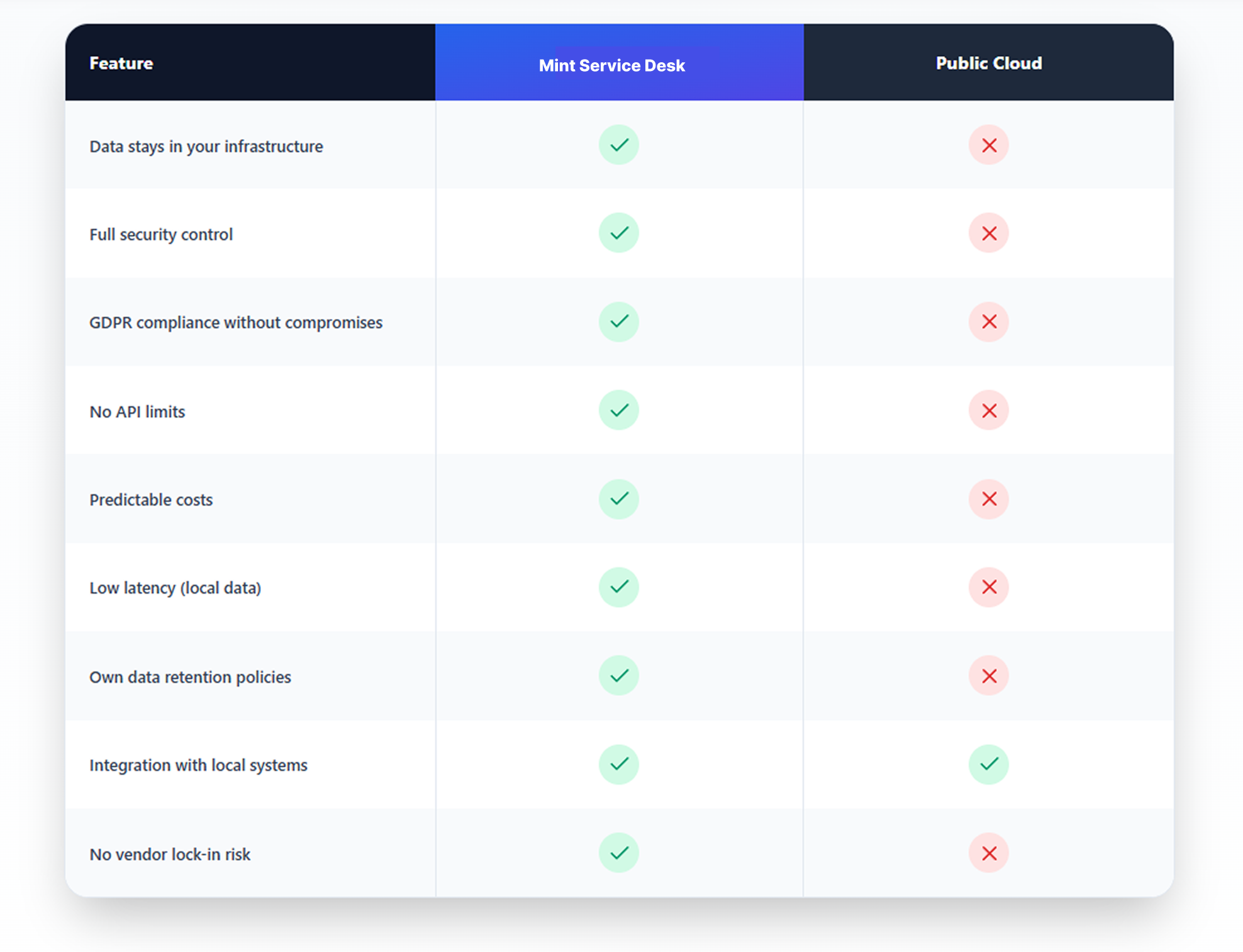
On-premises AI refers to artificial intelligence mechanisms deployed and operated entirely within an organization’s local environment. This means that all data processed by AI—ticket content, communication history, system details, and user information—remains inside the company’s infrastructure.
In practice, this provides full control over data flows and enables alignment with internal security policies and procedures. This approach is particularly important for organizations subject to strict regulatory requirements or advanced data classification rules.
On-premises deployment also reduces dependency on external AI providers, avoids unpredictable API-based costs, and ensures long-term operational stability. For many IT teams, these factors are decisive when choosing how to adopt AI.
Architecture of the AI Module in Mint Service Desk
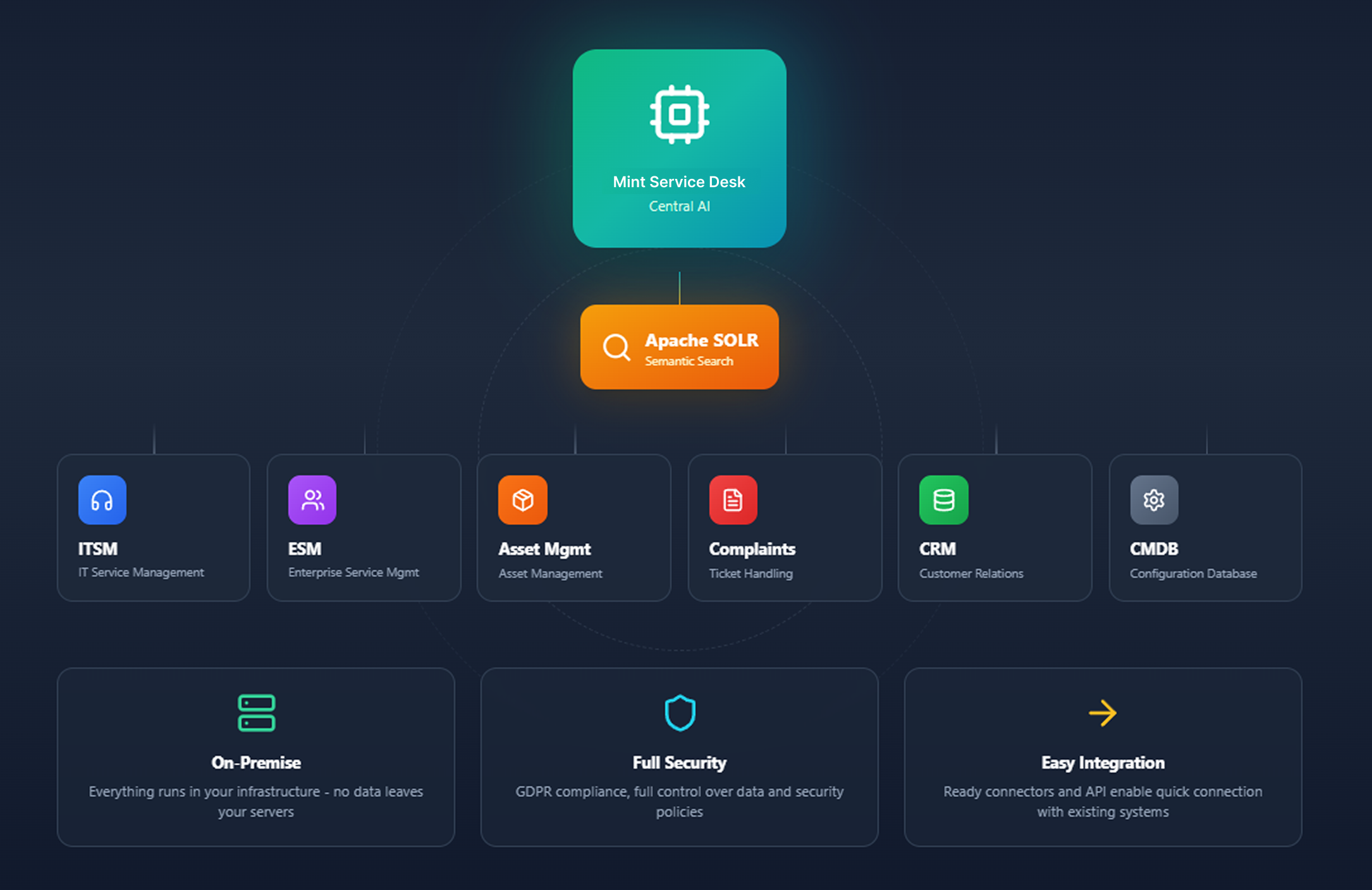
The AI module in Mint Service Desk was designed as a tool that supports agents rather than an autonomous decision-making system. Its primary function is to analyze ticket content and historical context while ensuring complete data isolation within the organization’s infrastructure.
All processing happens locally, without connections to external AI services or public models. This guarantees full data ownership and allows organizations to adapt the AI’s behavior to their processes, terminology, and communication standards.
Intelligent Agent Support in Ticket Handling
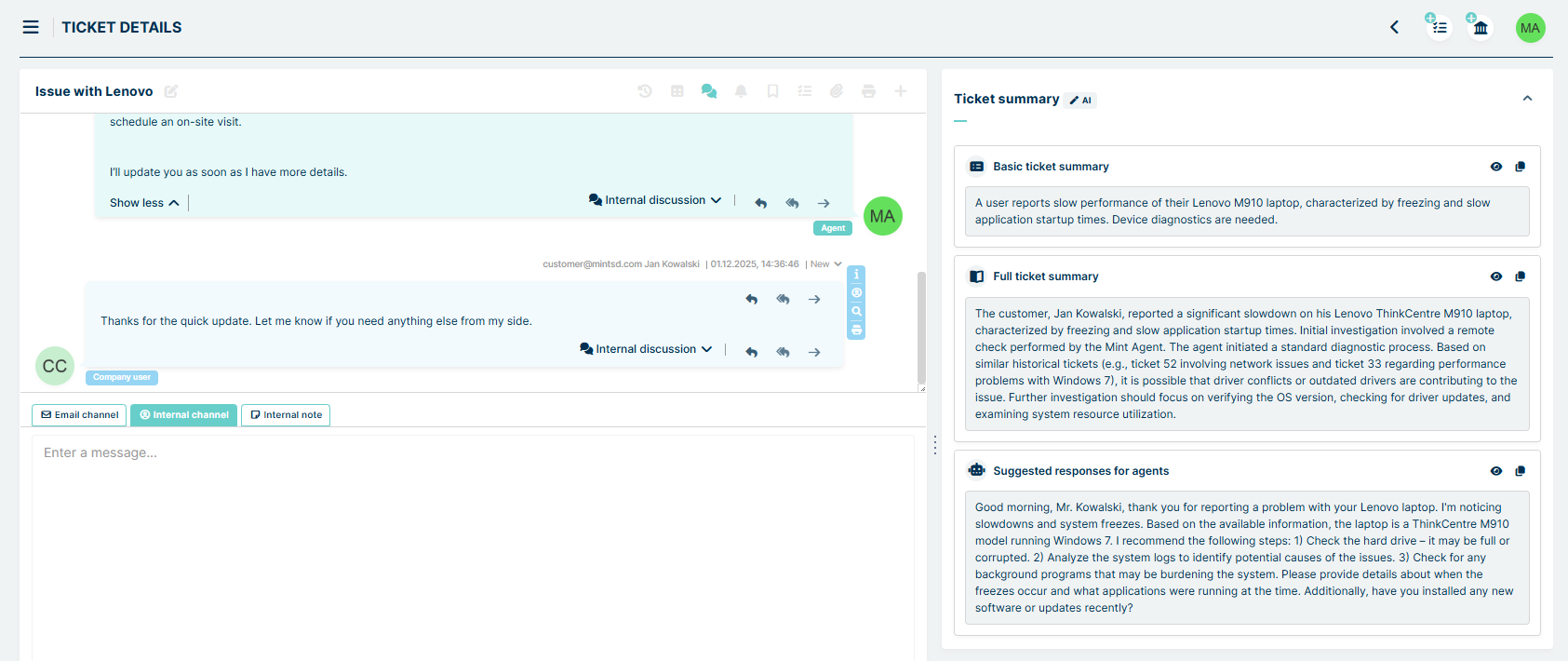
One of the most valuable capabilities of the AI module is its ability to actively support agents during ticket resolution. The system analyzes the ticket content and communication history and suggests relevant questions, diagnostic steps, or response elements.
As a result, agents can move more quickly toward accurate diagnosis, reducing the risk of missing critical details. This feature is particularly valuable for less experienced agents or teams handling a wide variety of technical issues.
Real-Time, Dynamic Ticket Summaries
Long communication threads are one of the biggest challenges in service desk work. The AI module in Mint Service Desk continuously generates an up-to-date summary of each ticket, reflecting both earlier decisions and the most recent messages from users or agents.
This allows agents to understand the current status of a case within seconds, without reading the entire conversation history. It is especially useful when tickets are reassigned or revisited after a longer period.
Automatic Keyword and Tag Detection
The AI module identifies important concepts within tickets, such as system names, applications, devices, error messages, and locations. This enables easier ticket classification, faster retrieval of related cases, and more accurate analysis of recurring issues.
Automatic tagging also improves reporting and trend analysis, supporting a data-driven approach to IT operations management.
Standardization and Onboarding Support
Maintaining consistent service quality across teams—especially in distributed or growing organizations—can be challenging. AI in Mint Service Desk helps standardize communication and resolution approaches by guiding agents in line with established procedures.
For new employees, the AI acts as an operational support layer, significantly reducing onboarding time and minimizing errors caused by lack of experience.
Data Security as a Core Architectural Principle
Every service desk ticket may contain sensitive information, including personal data, system configurations, infrastructure details, or internal processes. With an on-premises model, this data never leaves the organization’s environment, significantly reducing security risks.
Given the increasing number of regulations and internal security requirements, local AI processing is becoming the only acceptable option for many organizations.
Real Impact of AI on IT Team Efficiency
Organizations implementing AI-assisted agent support report tangible operational improvements. Shorter ticket resolution times, fewer errors caused by missing context, and improved communication quality all contribute directly to higher user satisfaction.
AI allows IT teams to focus on tasks requiring expertise and judgment, rather than spending time on administrative or repetitive activities.
On-Premises AI as the Future of ITSM
For many organizations, on-premises AI represents the next stage in ITSM maturity. After standardizing processes and implementing automation, the natural step forward is an intelligent analytical layer that enhances operations without compromising security.
Mint Service Desk follows this approach, positioning its AI module as a foundation for further intelligent capabilities built on internal knowledge, ticket history, and operational data.
AI Development Roadmap
The current AI module is only the beginning. Future development directions include intelligent search across local knowledge bases, analysis of technical documentation, log and configuration file insights, incident diagnosis support based on historical patterns, and contextual recommendations in approval, change, and RMA processes.
All enhancements are planned within the on-premises architecture, which remains a core element of the product strategy.
On-premises AI is reshaping how IT teams can adopt intelligent tools without compromising data security. The AI module in Mint Service Desk demonstrates how advanced technology can be aligned with real operational needs.
Rather than replacing agents, the system supports them by structuring information, improving context awareness, and enabling more focused, effective work. As a result, AI becomes a stable and predictable part of the ITSM ecosystem—supporting teams rather than introducing new risks.