Price increases in Service Desk and ITSM systems in 2025–2026
What’s a Rich Text element?
The rich text element allows you to create and format headings, paragraphs, blockquotes, images, and video all in one place instead of having to add and format them individually. Just double-click and easily create content.
Static and dynamic content editing
A rich text element can be used with static or dynamic content. For static content, just drop it into any page and begin editing. For dynamic content, add a rich text field to any collection and then connect a rich text element to that field in the settings panel. Voila!
How to customize formatting for each rich text
Headings, paragraphs, blockquotes, figures, images, and figure captions can all be styled after a class is added to the rich text element using the "When inside of" nested selector system.
1 element
2 element
3 element
1 element
2element
3 element
What is changing and why it matters
In 2025, the global Service Desk and ITSM market is clearly undergoing a shift in pricing strategies. Many vendors are updating their price lists or redefining their billing models in response to rising infrastructure costs, the rapid development of new features—particularly those based on artificial intelligence—and changing market expectations.
Instead of simple, one-time price increases, vendors are increasingly introducing models where the total cost of using a system grows with usage intensity, the number of interactions handled, or the scope of enabled functionality. These changes affect not only existing Service Desk users, but also organizations that are currently evaluating a new tool or considering a migration.
As costs become higher or more variable, purchasing decisions go beyond a basic comparison of plan prices. Organizations are paying closer attention to total cost of ownership, long-term budget predictability, and the risk of further pricing changes during the contract period. As a result, vendor pricing policies have become one of the key factors influencing decisions to stay with a current solution, renegotiate contract terms, or begin a migration to an alternative platform.
What has changed: price increases and “hidden increases” in billing models
In 2025–2026, three main mechanisms are driving higher Service Desk costs across the market:
1) Direct price increases
This is the most straightforward scenario: a vendor announces a price increase for selected plans. An example from the CRM + ticketing space includes an officially communicated average list price increase of approximately 6% for selected enterprise editions, effective from August 1, 2025.
At first glance, “only 6%” may not seem significant. The impact becomes much clearer when applied to dozens or hundreds of licenses, and when combined with rising costs of add-on services, integrations, and the internal effort required to maintain processes around the tool.
2) Function packaging and shifting value into higher tiers
In this case, list prices may remain unchanged on paper. Instead, features that are essential for daily operations—such as advanced incident handling or more sophisticated process controls—are moved into higher-priced plans. Organizations are typically offered a transition period and a message framed as “better alignment with the market.”
In one widely used ITSM and Service Desk ecosystem, such a change was announced as a “pricing & packaging update” effective October 16, 2024. While introduced earlier, its budget impact is most strongly felt during renewals and plan changes throughout 2025. These updates are often accompanied by consumption-based pricing for selected components.
This is the most disruptive shift of recent months because it directly affects cost predictability. AI in customer support is no longer treated as a standard feature included in a plan. Instead, it increasingly functions as a form of “fuel” that is billed based on usage.
In enterprise ITSM platforms, this is often described using concepts such as “assists” or other usage units, where different AI actions consume different amounts. Vendors publish guidelines on how to measure and track usage because billing becomes variable and usage-driven.
In tools aimed at small and mid-sized businesses, a similar effect appears through transitions from “per agent” pricing to models based on the number of contacts or interactions handled, as well as migrations from legacy plans to new pricing structures with notice periods measured in months.
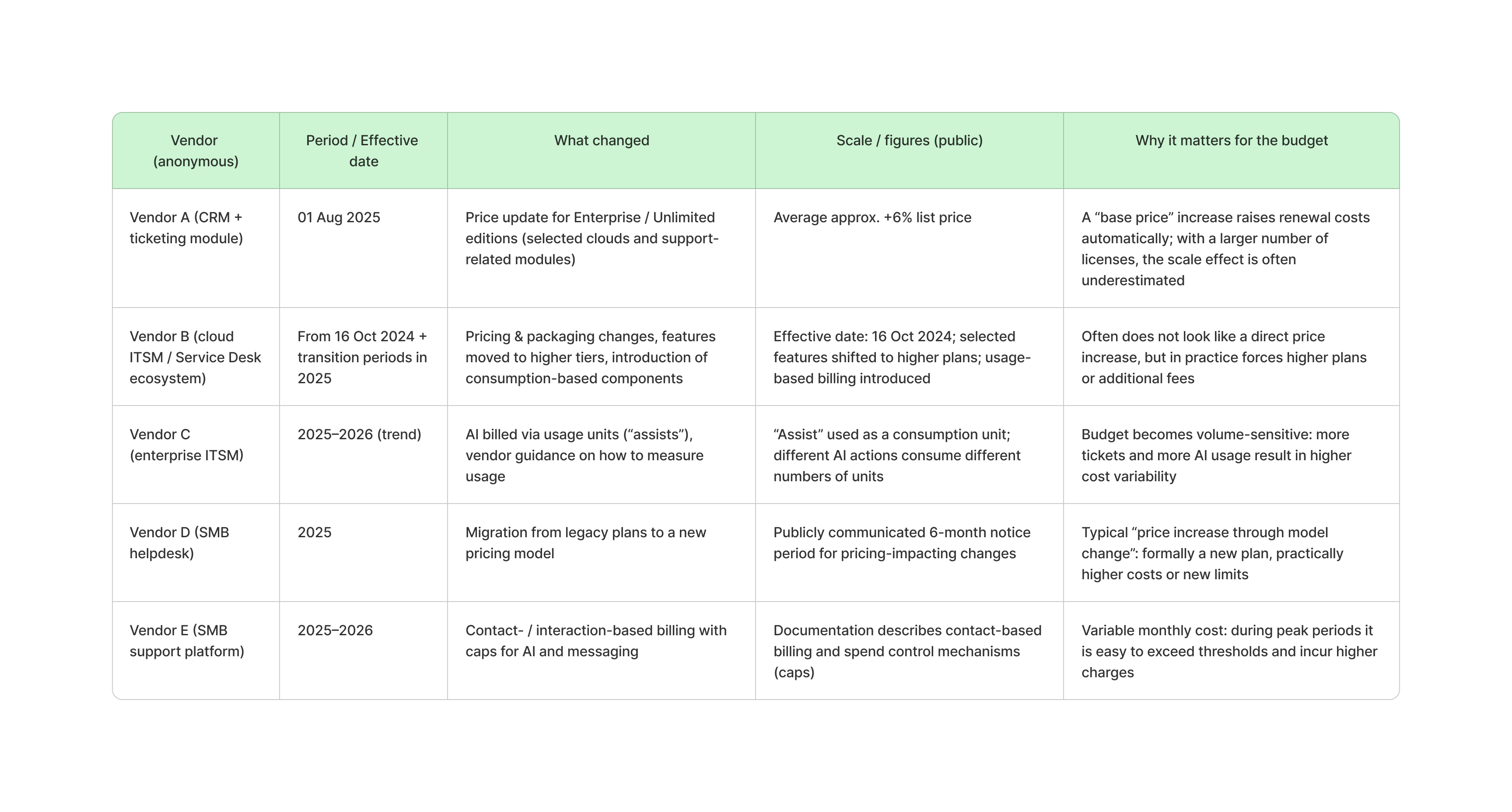
Example pricing and model changes (2025–2026)
Below is an overview of commonly observed changes, including specific numerical values where vendors have published them officially. Individual vendors are described anonymously, while the information is based on public announcements, product documentation, and official pricing updates.
Why is this happening?
There is no single cause behind these changes. The current situation is the result of overlapping product and economic factors that together shape how vendors design their pricing and billing models.
1) AI is expensive to operate, so it is no longer always bundled
Artificial intelligence is increasingly treated as a standalone component with its own cost structure. This reflects both the real cost of computation and the fact that AI has become a key competitive differentiator. As a result, vendors introduce billing models based on usage intensity—such as the number of interactions, operations, or queries. Product communication increasingly focuses on how to monitor usage, because it directly determines the final cost of the solution.
2) Vendors are restructuring and simplifying their product portfolios
Changes described as “package updates” or “portfolio optimization” often redefine what is considered standard functionality. Features that were previously available in mid-tier plans are moved into higher-priced options. Organizations that rely on these capabilities usually receive a transition period, after which they must decide whether to accept higher costs or modify how their processes are implemented.
3) Operational stability has become something the market is willing to pay for
Service Desk systems are now critical to day-to-day operations. Vendors know that switching tools requires significant effort: data migration, process rebuilding, configuration of automations, integrations, and reporting. The more deeply a system is embedded in operational workflows, the harder migration becomes—effectively increasing the market’s tolerance for gradual price increases.
What this means for your organization: budget, control, and risk
In theory, each of these billing models can be considered reasonable. In practice, the main issue is rarely the price itself. The real challenge is unpredictability and growing cost complexity, which is difficult to capture in a single, transparent view.
Common signals that costs are starting to get out of control:
You are using a higher-tier plan mainly because you need a few specific features, while the rest of the package adds little value.
Total cost increases incrementally as you add AI modules, advanced reporting, integrations, analytics, additional roles, or test environments.
It is difficult to calculate the true end-to-end cost of handling a single ticket when licenses, team effort, and system maintenance are all considered.
There is limited visibility into which teams, channels, or ticket types generate the highest operational and financial load.
Internally, everyone feels that costs are rising, but there is no simple, data-driven way to defend or plan the budget.
A short practical example
Consider a team of 30 agents. A seemingly modest 6% increase in base pricing affects all license-based components. In practice, this means not only a higher cost for the core plan, but also proportional increases in expenses for AI modules, feature bundles, and integrations. While the communicated increase may be “an average of 6%,” total cost of ownership often rises more sharply because organizations use specific features—not an abstract average offering.
Why many organizations decide to change now
Organizations rarely migrate Service Desk tools simply because another option is “slightly cheaper.” A decision to change usually emerges when several factors converge at the same time.
First, a price increase or billing model change causes previously planned budgets to stop adding up. Second, operational frustration grows—the tool that was supposed to streamline work starts to complicate it and requires manual workarounds. Third, the organization reaches a certain level of process maturity: teams know how they want to work and are less willing to accept chaos caused by tool limitations or unpredictable pricing.
Quick check: is your company already overpaying?
Answer “yes” or “no” honestly:
Has the cost of your tool increased over the last 12 months, even though team size has remained largely unchanged?
Do you feel that you mainly use a few key features, but have to pay for a higher plan to access them at all?
Are AI-related, message-based, or contact-based costs difficult to predict in advance?
Does every contract renewal turn into a “damage control” negotiation to keep costs under control?
Does your team spend too much time manually managing tickets instead of resolving them?
If you answer “yes” to two or three questions, it is usually worth calmly comparing alternatives. With four or five “yes” answers, the cost is no longer purely financial—it also includes lost time, frustration, and reduced team efficiency.
In 2025–2026, the Service Desk market is clearly moving toward higher prices and billing models that introduce greater cost variability—ranging from AI usage fees and consumption limits to structural changes in feature packaging. Publicly announced pricing updates show that even relatively small percentage increases, when combined with new billing rules, can significantly affect total cost of ownership.
For organizations, this means one thing: without a simple and transparent cost model, it is easy to overpay—even if the tool itself still performs well. At Mint Service Desk, we consistently focus on stable pricing and predictable billing principles, making it easier to plan budgets and develop customer support without the risk of unexpected changes along the way. If your organization is currently facing a price increase or a billing model change and considering migration, this process can be carried out step by step—without a large-scale implementation and without disrupting daily operations.